
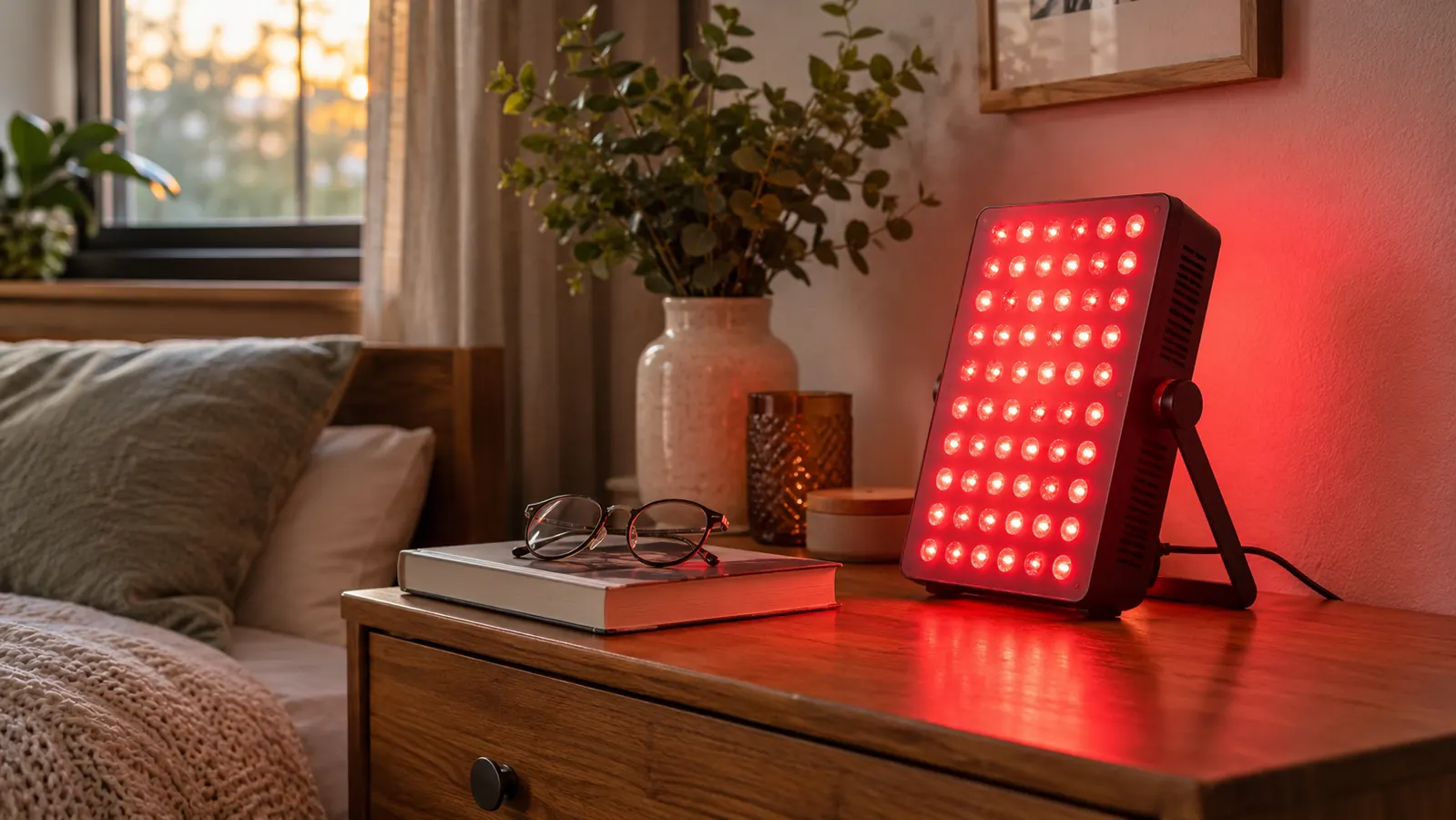
If you're weighing a tabletop panel like the Viconor Red Light Therapy Lamp against one of those full-size floor panels, here's the short answer: buy the one you'll actually use on a Tuesday night when you're tired. For me, that turned out to be the Viconor. It sits on the dresser in our spare bedroom, takes about ten seconds to set up, and I can carry it to the living room couch when Ray and I are watching a movie. A floor panel covers more of you in one session, but only if you actually stand in front of it.
I'm Carla Benton, a retired dental hygienist in Savannah, Georgia. I started at-home red light therapy about two years ago, mostly for stiff knees from thirty years standing chairside and for skin that has seen one too many Georgia summers. Before I bought anything, I spent a long time looking at the big floor panels. They're impressive machines, and I don't want to talk anyone out of one. But I also spent a week using my friend Diane's floor panel in her home gym, and the comparison taught me more than any spec sheet ever has. This is what I'd tell you if we were sitting at my kitchen table.
| Viconor panel | Full-size floor panel | |
|---|---|---|
| Cost | A fraction of the cost of a floor panel. A much smaller commitment for a first-time buyer. | Usually several times the cost of a tabletop panel. A bigger investment before you know the routine will stick. |
| Footprint | About 16.7 by 12 inches and roughly 7 pounds. Sits on a nightstand, dresser, or coffee table and disappears when not in use. | A tall panel on a rolling base. Needs a clear stretch of floor and a spot where it can live permanently. |
| Body coverage | Face, neck, hands, and knees, one targeted area at a time. You move the panel to the part of you that's asking for attention. | Front and back of the body at once, head to hip. One session covers what takes several with a tabletop. |
| LED array | 120 LEDs in a curved surface designed to focus the light on the area you aim at. | A much larger array spread over a bigger surface, so more light reaches more of you at once. |
| Portability | Light enough to carry from the spare bedroom to the couch. Easy to pack away when company comes. | Heavy enough that it stays where you put it. Moving it becomes a project. |
| Best for | Small homes, movie nights, quick face and knee sessions, first-time buyers. | Whole-body sessions for people with a dedicated space and a firm routine. |
Where Viconor Wins
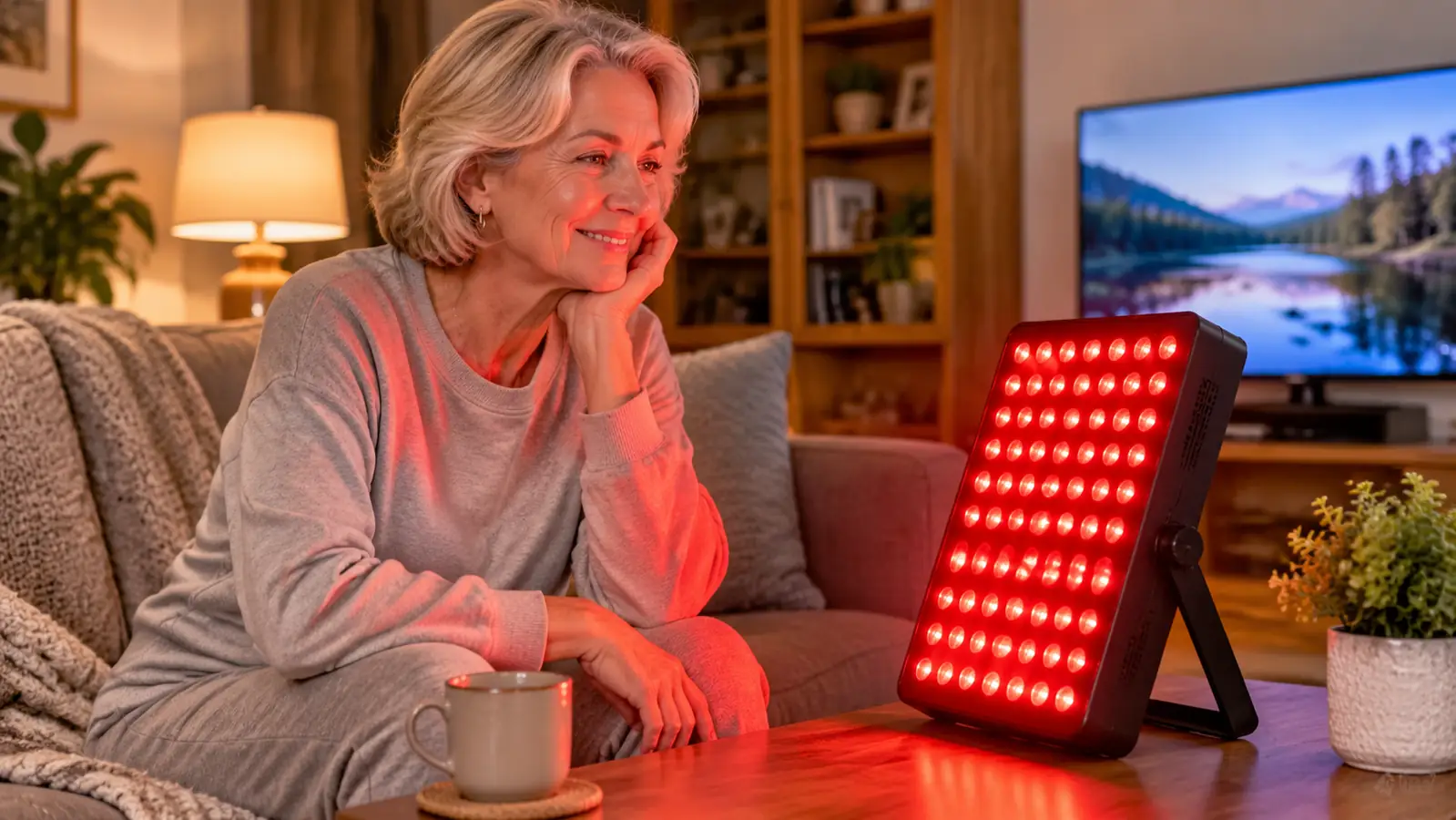
The biggest win for the Viconor is that it fits a real life. The package dimensions are about 16.7 by 12 inches and it weighs just over 7 pounds, so it lives on the dresser in our spare bedroom instead of in a closet. I run it for 15 to 30 minutes most evenings, usually while Ray and I are watching a movie. I set it on the coffee table, aim it at my knees, and forget about it until the credits roll. The first night I used it was a Thursday, and I had it out of the box, aimed at my knees, and running before the opening scene of the movie finished. That was the moment I knew the tabletop size was right for us. No furniture moved, no cords stretched across the walkway, nothing to put away afterward except the panel itself. That ease is the whole point. A device you can use without rearranging the room is a device you'll actually use.
The other win is the cost, and I don't mean that lightly. A full-size floor panel is usually several times the cost of a tabletop panel, which makes it a harder first purchase to justify. The Viconor is the kind of thing you can buy without a big internal debate, and that matters when you're still figuring out whether red light therapy fits your routine. The curved surface design is meant to focus the light, so the 120 LEDs work on the area you aim at rather than scattering across the room. For targeted work on a face, neck, or knee, that focus is genuinely useful.
Where a Full-Size Floor Panel Wins
I'll be honest with you: the floor panel I borrowed covered a lot more ground. A full-size panel is tall enough to treat your whole front or your whole back at once, head to hip, which the Viconor simply cannot do. If your goal is whole-body sessions, a floor panel does in one session what would take me three or four separate sessions with the tabletop. That is a real advantage, not a marketing line. My friend Diane uses hers in a home gym, and it earns its spot there in a way it never would in our spare bedroom.
The bigger LED array is the other thing I noticed. More surface area means more light hitting more of you at the same time, and for someone with the space and the budget, that is genuinely nicer. A full-size floor panel also fits a standing routine. You step in front of it, run your 20 minutes, and step away. If that sounds like you, the floor panel is the better tool, and I'd never argue otherwise. The point of this whole comparison is to match the tool to the life, not to pretend one panel is better at everything.
I should also mention that a floor panel is a statement piece in a room. The one I borrowed dominated the corner it stood in, and Diane chose its spot carefully. If you have a home gym or a spare room that can wear it, that's not a problem, it's a feature. But in a lived-in living room, a six-foot panel on a rolling stand changes the feel of the space in a way a tabletop never will.
Start with the panel you'll actually use
The Viconor Red Light Therapy Lamp with Stand puts 120 LEDs in a compact, curved panel you can move from the dresser to the coffee table. Check today's price on Amazon and see if it fits your evenings.
Amazon Check Today's Price on Amazon →A floor panel covers more of you in one session, but the Viconor is the one I reach for most evenings. The best device is the one you'll actually use.
What I'd Check Before You Buy
Before you buy either one, check the wavelengths. The Viconor lists 660 nm red light and 850 nm infrared, and each of its 120 LEDs includes both. That is right there in the listing, and it's the kind of detail worth matching against whatever floor panel you're considering. I checked the Viconor listing three times before I bought it, mostly to be sure about the 660 nm and 850 nm numbers. When I borrowed Diane's floor panel, I asked her to pull up its listing too, and we compared them side by side at her kitchen table. Hers listed different wavelengths, which is fine, but I wanted to know what I was comparing before I compared it. Panels differ in what they put out, and you want the one you choose to be clear about its numbers. If a listing is vague about wavelength, I'd treat that as a sign to keep looking.
Then check the daily time commitment honestly. The Viconor listing says 15 to 30 minutes a day, which is a realistic ask for most people. A floor panel may suggest similar session lengths, but you'll likely be standing for them, and that changes how the routine feels. Ask yourself which one you'll stick with on a Tuesday night when you're tired, or on a humid August evening when the last thing you want is to stand in front of a machine. For me, the answer was the panel I could use sitting down.
How the Viconor Fits a Small Home
This is worth saying plainly: our house in Savannah is not a big house, and the spare bedroom corner is already doing a lot of work. A full-size floor panel would need a permanent spot, and we don't have one to give. The Viconor, at about 7 pounds, moves easily between the dresser and the coffee table. When company comes, it goes back in the closet in under a minute. That flexibility is exactly why a tabletop panel makes sense for a small home, and it's the reason I'd point most people at one before they spend on a floor model.
One more thing about the small-home angle: the Viconor works right out of the box, and the stand means you're not hunting for a way to prop it up. That sounds like a small thing until you've tried to balance a panel against a stack of books. The listing says it's designed to work right out of the box, and in my experience that's true. Less setup friction is one more reason a tabletop panel wins for most people most of the time.
How a Session Goes at Our House
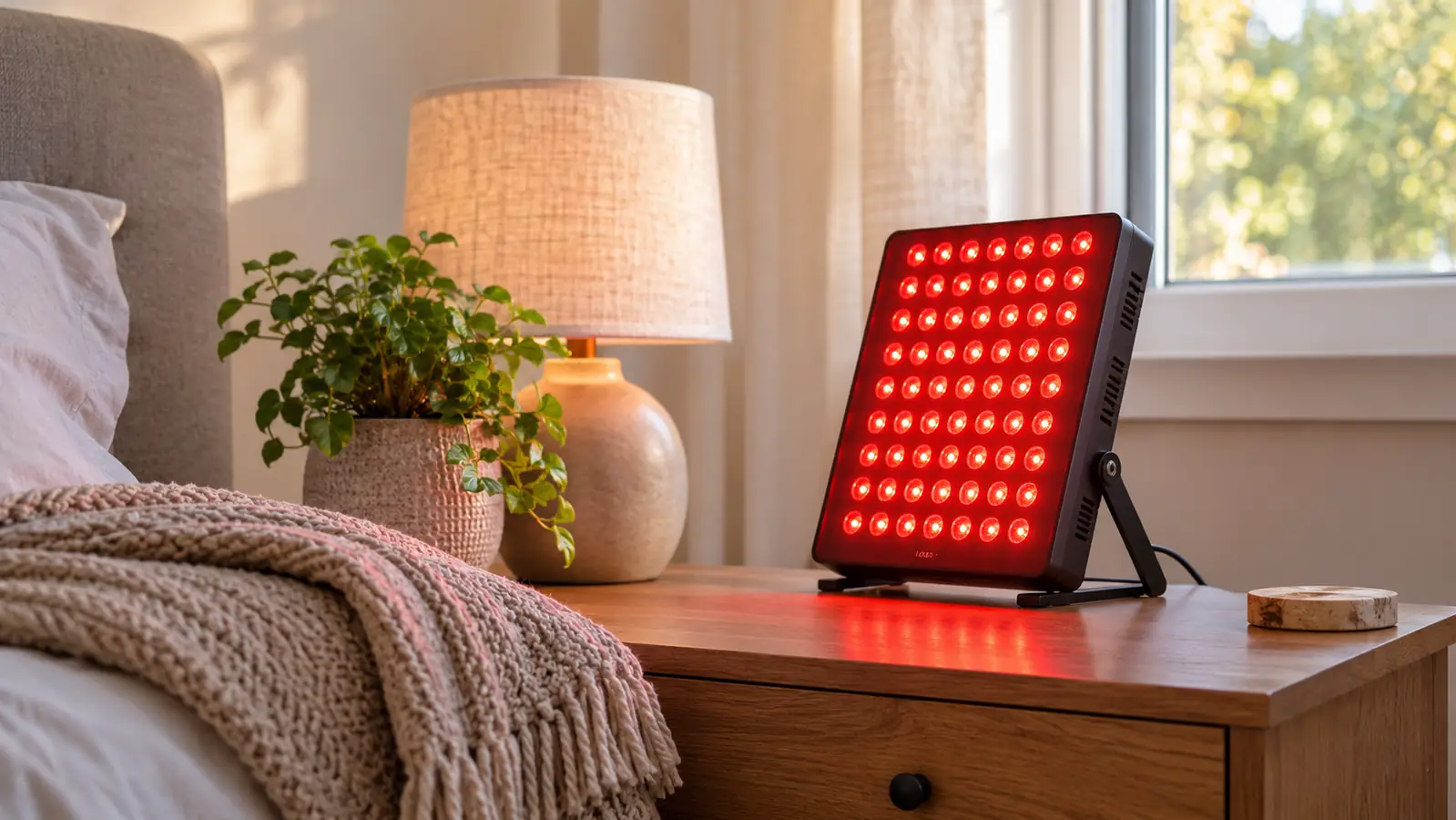
Most evenings, I set the Viconor on the coffee table, plug it in, and sit on the couch with it aimed at my knees. The listing recommends 15 to 30 minutes a day, and I usually land somewhere in the middle of that. Ray and I pick a movie, the panel glows red, and the time passes without me thinking about it. Last Tuesday, I ran a full 30 minutes during a movie Ray had already seen, and I didn't check the clock once. I only knew the session was over when the movie paused for a bathroom break and I noticed the panel had been glowing the whole time. That is the difference between a routine that sticks and one you have to talk yourself into. If a device makes you count the minutes, you'll stop using it.
On days when my knees are more of a project, I move the panel to the spare bedroom and set it on the dresser while I read. The stand keeps it steady, and the curved surface means the light stays where I aim it. It takes longer to describe than it does to do. With a floor panel, the same session would mean walking to another room and standing for the whole 20 minutes. Both get the job done. One of them fits my Tuesday night better.
One More Difference: The Stand
The Viconor comes with a stand, which sounds like a minor detail until you realize how much it changes where you can use the panel. On the coffee table, the stand angles it toward my knees. On the dresser, it angles it toward my face. One Saturday morning I used it on the dresser for a face session while I folded laundry, and that same evening it was back on the coffee table aimed at my knees. Two sessions, two spots, one device, no tools and no wrestling with a heavy base. A floor panel's stand does the same job, but it commits you to one spot. I like having the option to move the light to the part of my body that's complaining today.
Who Should Buy Which
Buy the Viconor if you want something you'll reach for most days. It suits a small home, a modest budget, and a routine built around the couch and the spare bedroom. It's the right call if your main targets are your face, neck, hands, and knees, the areas most of us actually complain about. And it's the right call if you're new to red light therapy and want to find out whether you'll stick with it before you spend floor-panel money.
Buy a full-size floor panel if you have a dedicated space for it, a budget that can absorb it, and a goal of whole-body sessions. If you already know you'll stand in front of it for 20 minutes a day, the bigger panel is the better tool, and I'd be the first to say so. But if you're not sure yet, the Viconor is the lower-risk way to find out. You can always add a floor panel later, and the tabletop will still earn its keep for face and knee sessions.
The Tradeoff That Decided It For Me
For me, the deciding factor was simple: I wanted a panel I could use while sitting on the couch with Ray. The floor panel is a better whole-body tool, no question. But our evenings are movies, not workouts, and the Viconor fits the life we actually have. A tool you use is worth more than a better tool you skip, and that sentence has decided more of my purchases than any spec sheet ever has.
I'll also say this: I don't regret the tabletop choice for a second, and I don't think I'm missing out. The Viconor does what I need it to do, where I need it to do it, and it doesn't ask for a room of its own. If my knees or my face were the whole project, that's a different conversation. But for a 58-year-old who wants to watch a movie and run a session at the same time, the Viconor is the honest answer.
See if the Viconor fits your evenings
If you're still weighing a tabletop panel against a floor model, the Viconor is the lower-risk place to start. Check today's price on Amazon and decide with the numbers in front of you.
Amazon Check Today's Price on Amazon →