
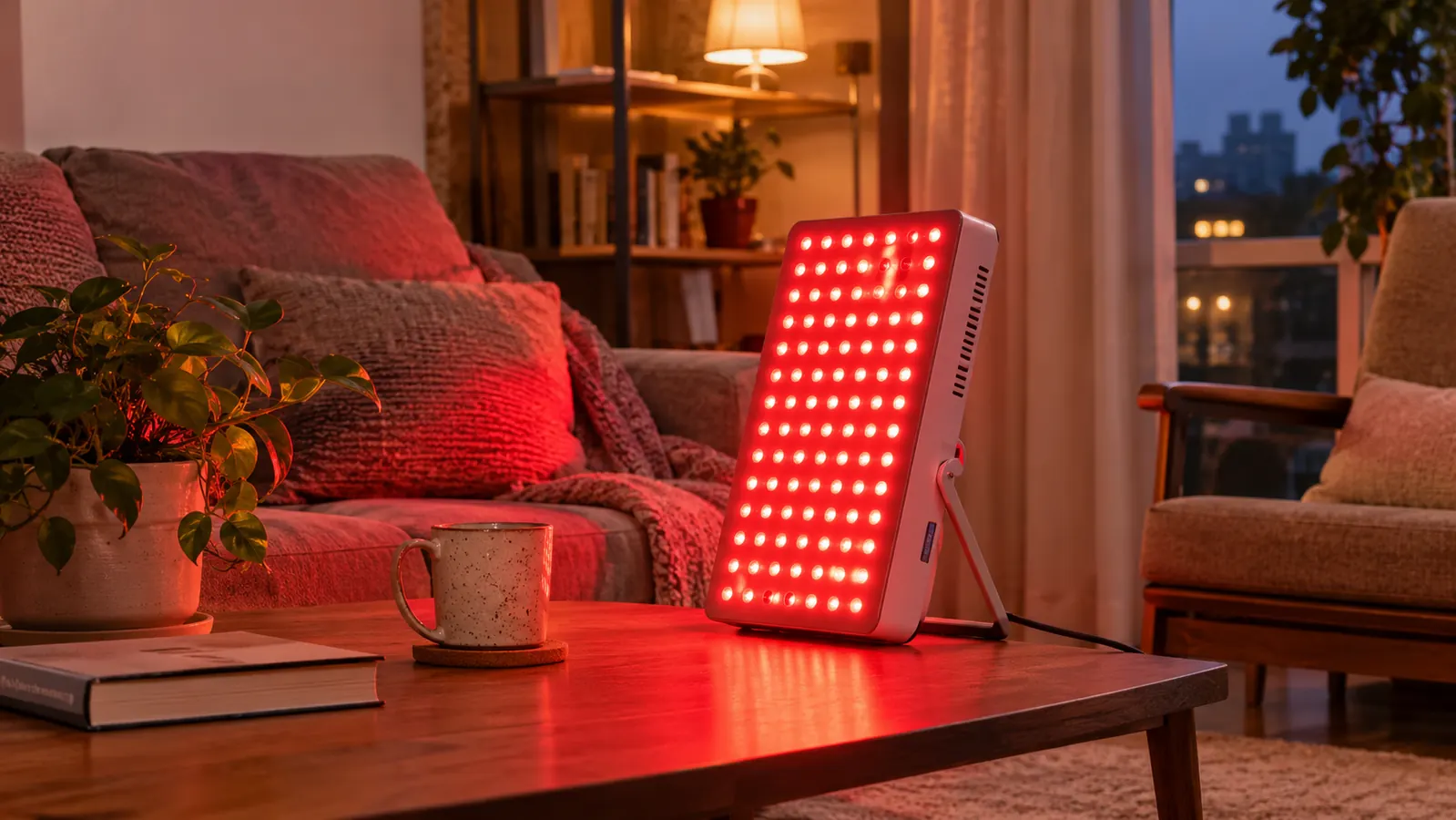
I'll start with the part that usually gets left out of a review like this: I wanted the Viconor panel to work. I'm Carla Benton, I'm 58, and I spent 30 years as a dental hygienist standing at a chair, so my knees let me know about it every single morning. When red light panels started showing up everywhere, I was exactly the kind of person who would talk herself into one. I bought this Viconor red light therapy lamp for face and body with stand about six weeks ago, and I've used it almost every evening since. This is the honest version, the good and the not so good, told the way I'd tell it to a friend at my kitchen table in Savannah.
Before anything else, the disclaimer that matters. I'm not a doctor and I'm not a scientist. I'm a retired hygienist who reads a lot and pays attention to her own body, and nothing I say here is medical advice. If you're considering red light therapy for a specific condition, check with your doctor before you spend a dime. What I can give you is a plain-spoken account of what it's like to own this panel, what the listing says versus what the box actually contains, and the few things I wish somebody had told me before I clicked buy.
The Quick Verdict
A well-made tabletop panel that does what it says if you can commit to daily sessions. The honest catch is the time and the positioning, not the light.
Amazon Check Today's Price →The Viconor panel I tested is the one I still reach for every night
Here's the short version before you read the long one: after six weeks of daily use, I think it's a solid buy for someone who will actually sit still for fifteen minutes. Check today's price on Amazon and see whether it fits your routine.
Amazon Check Today's Price on Amazon →How I've Used It
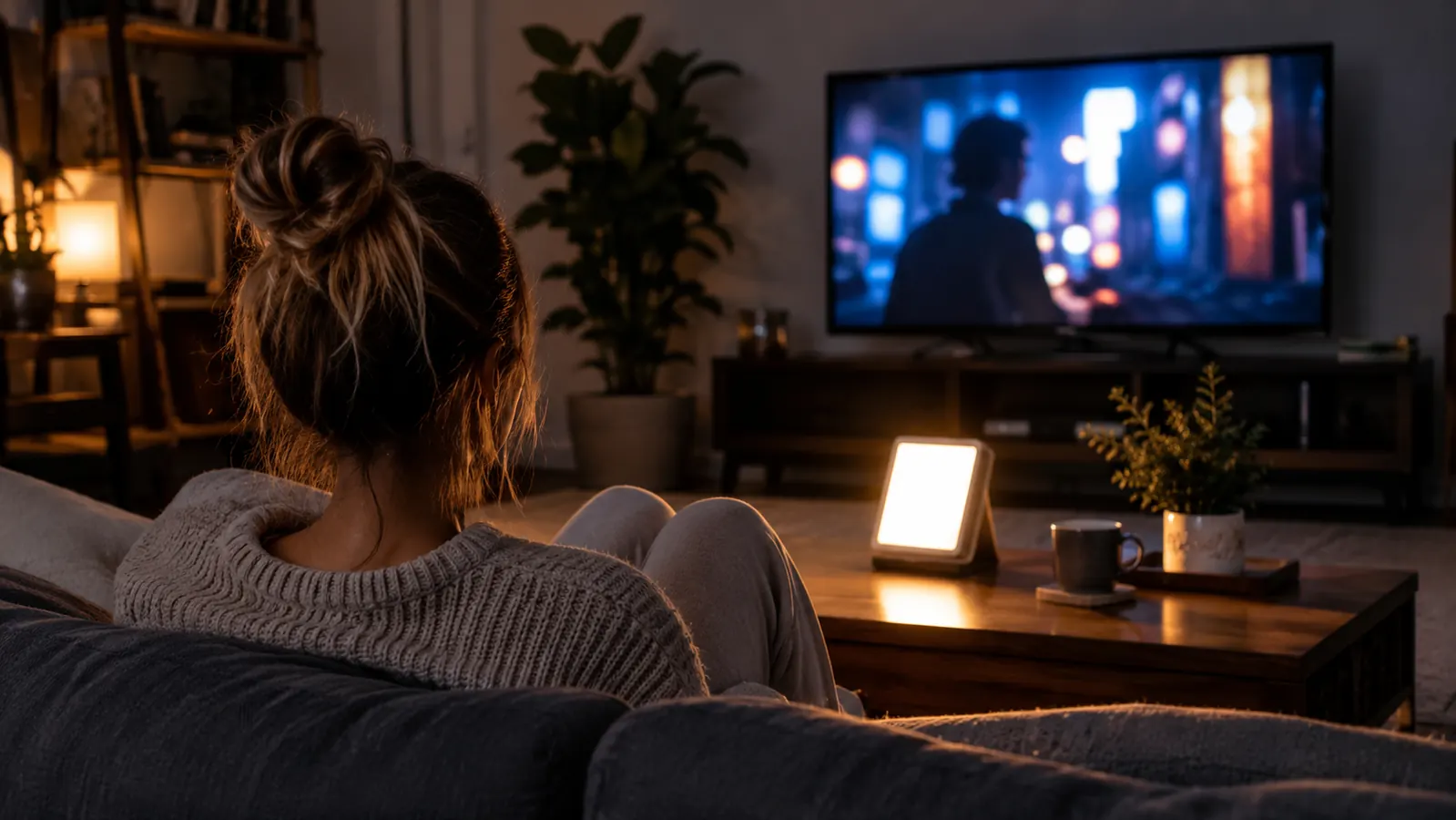
My routine is boring, and I think boring is the point. Most evenings after dinner, Ray and I settle into the living room, I prop the Viconor panel on the coffee table, and I sit with it while we watch a movie. The instructions say 15 to 30 minutes a day, so I aim for about 20. I'll keep it at face level for a stretch, then move it down to my knees for the last few minutes. It's not a dramatic ritual. It's just a thing I do, like brushing my teeth, and that consistency is what I think actually matters.
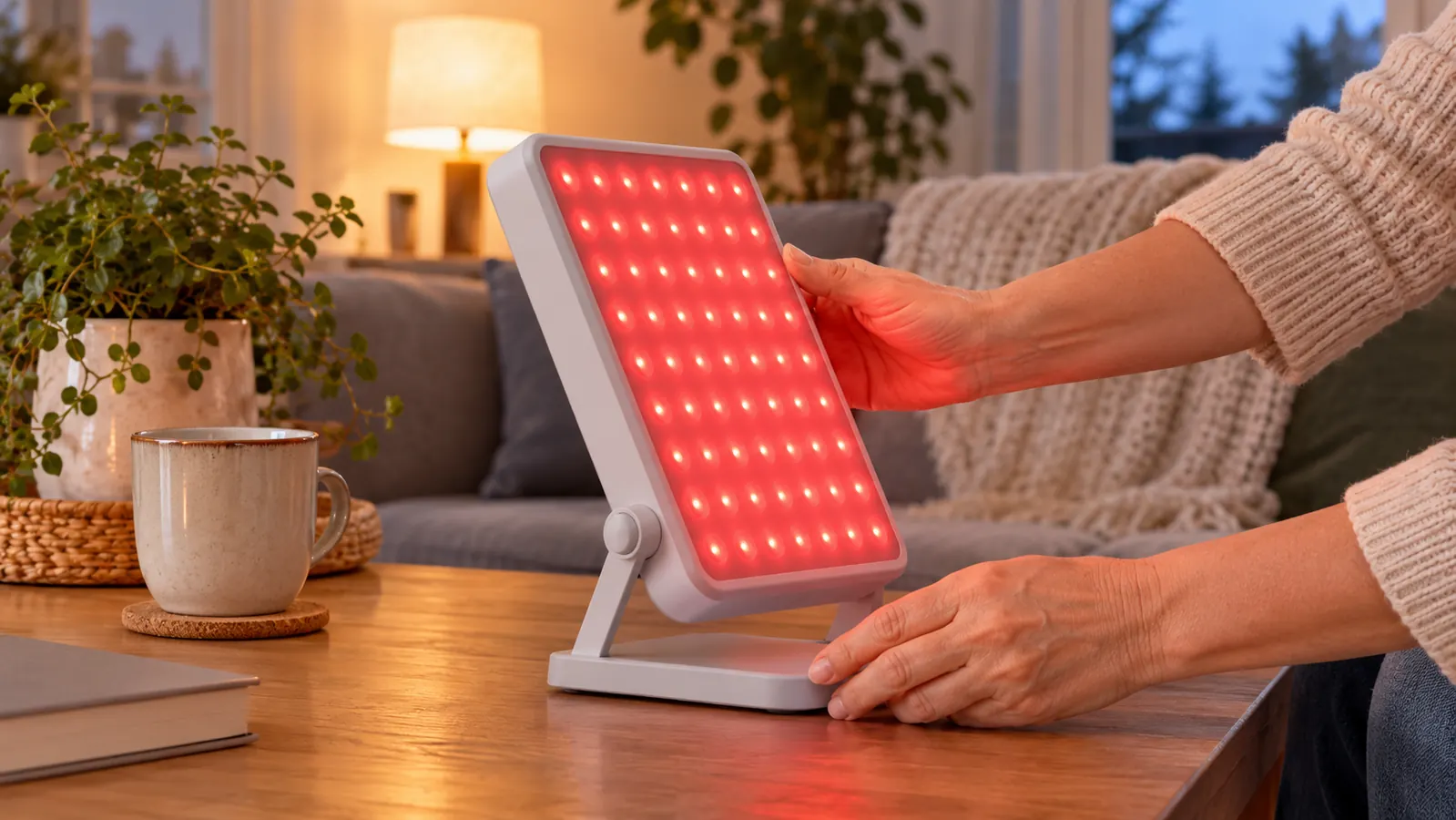
The stand is the detail I didn't expect to care about. The listing calls it a lamp for face and body with stand, and the stand is genuinely useful. It holds the panel upright on the table, and the angle means I can point the light where I want it without holding the panel in my hands. The whole thing weighs about seven pounds, so it's not flimsy, but it's also not so heavy that I can't move it from the coffee table to the spare bedroom when I want a session lying down.
I'll also be honest that I almost didn't buy it because I wasn't sure a tabletop panel would cover enough area. The panel is compact, and the box is roughly sixteen by twelve inches, so this is not a full-body wall of light. But for what I use it for, face and knees, it's plenty. I sit close, about a foot away, and the curved surface seems to focus the light into the area I'm aiming at. If you're used to seeing people stand in front of huge panels in videos, this is a different experience entirely, and that's okay.
What the Spec Sheet Actually Says
Let's talk about what's actually in the box, because the marketing language can get a little much. The Viconor panel has 120 LEDs. Each LED combines 660 nanometer red light, which is visible, and 850 nanometer infrared, which you can't see. That split is worth understanding before you buy, because some people expect a bright red glow and then worry the panel is broken when it looks dimmer than the photos. The visible red is there, but a lot of the output is infrared, and you can't see that part at all.
The curved surface is the feature the company talks about most, and after using it, I get it. The panel bows slightly, which focuses the light instead of letting it scatter everywhere. Whether it doubles the effect, as the listing claims, I can't prove, and I'd be suspicious of any claim that specific. What I can say is that the curve makes aiming easier. I can tell where the light is going, and I don't feel like I'm wasting half of it on the ceiling.
The instructions say to use it 15 to 30 minutes a day, and I think that time commitment is the real price of admission. Not the cost of the panel. The fact that you have to sit still, in front of a light, for a quarter of an hour, every single day, for weeks, before you can form any opinion about whether it's doing anything. If that sounds like a chore, this is not the product that will change your mind.
What I Noticed in Six Weeks
Now the part everybody actually wants, which is what I noticed. I'll separate it into things I'm confident about and things I'm only fairly sure about, because that's the honest split. The thing I'm most confident about is that the routine itself has been good for me. Twenty minutes of sitting still, not looking at a phone, just breathing, is more pleasant than I expected. Ray teases me that I've turned a lamp into a meditation practice, and he's not entirely wrong.
What I'm fairly sure about, and I want to be careful here, is that my knees feel a little less cranky in the morning than they did before I started. I'm not going to claim cause and effect, because I'm also stretching more and I've been walking a bit more. But the timing lines up, and the difference is noticeable enough that I haven't missed a session in weeks. I don't keep a journal, which I now regret, because the change was gradual enough that I can't pin it to a date. On my skin, my face looks a little less tired by the end of the day, though that could easily be the extra water I've been drinking or just the comfort of doing something nice for myself.
Here's what I did not experience: no dramatic change, no overnight difference, nothing that would make me tell you to run out and buy one today. If you read reviews expecting fast results, this is the part you need to hear. The people who love this panel are the people who used it consistently for a month or two and then looked back and realized something felt a little better. It's that kind of product. Slow, subtle, and easy to dismiss until you stop doing it.
The Part Nobody Tells You
So let's get to the honest gripes, because a review that only raves is doing you a disservice. First, the positioning. The panel works best when you're sitting close to it, which means you have to arrange your evening around it. I've had sessions where I realized I was holding my head at an awkward angle because the panel was on the coffee table and I was on the couch. Test the height before you commit to a routine, and don't be shy about stacking a book or two under the stand.
Second, the panel gets warm. Not dangerously hot, and not enough to bother me, but it's not a cool little gadget either. After twenty minutes the front of the panel is warm to the touch, which is worth knowing if you have curious pets or small kids around. It's also a visible object. It's a lamp on a stand, and it's not the kind of thing that disappears into your decor. If you care about the look of your living room, think about where it's going to live before it arrives.
Third, and this is the one I really wish someone had told me: the panel only does its job if you're consistent, and consistency is harder than it sounds. The first week is easy because it's new. The second week is fine. The third week, when you're tired and the movie is good and you just want to go to bed, is when you find out if this is a product you'll actually use. I've kept up with it, but I can see how most people would quietly stop. Before you buy, ask yourself honestly whether you'll sit in front of a light for fifteen minutes a day for two months. If the answer is no, save your money.
Fourth, the placement. The panel needs to be near an outlet, and the spot that works for the light may not be the spot that works for your furniture. I had to rearrange my coffee table slightly so the panel could reach. Once I found the right spot, it became a non-issue, but the first few evenings involved some moving of furniture. It's a small thing, but it's the kind of small thing that tells you whether a company thought about real living rooms when they designed the product.
What I Liked
- 120 LEDs combining visible 660 nm red light with 850 nm infrared
- Curved surface focuses the light and makes aiming easy
- Stand holds the panel upright for hands-free sessions
- Around 7 pounds, easy to move between rooms
- Simple daily routine that's genuinely easy to stick with
Where It Falls Short
- The real cost is time: 15 to 30 minutes a day, every day
- Positioning matters and the height may not suit your couch
- Results are slow and subtle, not dramatic
- The panel runs warm during longer sessions
- Placement depends on being near an outlet
The people who love this panel are the ones who used it every day for two months and then looked back and realized something felt a little better. It's that kind of product: slow, subtle, and easy to dismiss until you stop doing it.
Who This Is For
I think the Viconor panel is a good fit for a specific kind of person, and I'd rather you know whether that's you before you buy. It's for someone who already has a daily routine they can attach this to. If you sit down every evening to watch a show, or you read for half an hour, or you have a stretching habit, this slots right into that existing time. You're not adding a new chore to your day. You're just pointing a lamp at yourself while you do something you already do.
It's also for someone who goes in with realistic expectations. The panel is a tool for consistency, not a magic wand. If you understand that you're committing to a month or two of daily sessions before you'll have any real opinion, you'll be happy with it. And it's for someone who wants to try red light therapy without dedicating a whole room to it. This fits on a coffee table, and that's a real advantage over the big full-body panels.
Who Should Skip It
On the other side, I'd skip this if you're hoping for a quick answer. If you want to know in a week whether red light is going to help you, a tabletop panel will frustrate you. I'd also skip it if you can't sit still. Some people just can't do the sitting part, and there's no shame in that, but it means the panel will end up in a closet by week three.
And if you're looking for a full-body solution, this isn't it. The panel covers a face and a pair of knees at a time, not your whole body. For that you'd want one of the larger panels, and those are a different budget and a different amount of space. The honest advice is to measure your expectations against the size of the device before you order.
Questions I'd Ask Before You Order
If you're still on the fence, here are the questions I'd ask yourself, and honestly the questions I wish I'd asked. Where will this live? It needs a flat surface, a nearby outlet, and a spot where you'll actually sit in front of it. How much time are you willing to give it? If the answer is less than fifteen minutes a day, this isn't the product for you. And what are you hoping it will do? Write that down, because in eight weeks you'll want to compare against it.
One more practical note: check the return policy before you buy, and take a photo of the panel the day it arrives. The Viconor panel is well packaged, and mine arrived without a scratch, but a little documentation never hurt anyone. When it arrives, set it up and do a quick test run while it's still easy to send back, so you know everything works.
What I'd Tell a Friend
If a friend called me tonight and asked whether to buy this, here's what I'd actually say. Buy it only if you're ready to use it every day for two months, and don't expect to feel anything in the first two weeks. Set it up somewhere you already sit, keep the box for a while, and treat the whole thing as a slow experiment with yourself. If you can do that, the Viconor panel is a reasonable thing to try. If you can't, save your money and revisit the idea later. There's no harm in waiting a season either, especially if you're the kind of person who buys things and then forgets they own them.
My honest bottom line on the Viconor panel
It's a good panel for the right person, and after six weeks I'm still using mine every night. If that sounds like you, check today's price on Amazon. If it doesn't, I hope this review saved you the trouble.
Amazon Check Today's Price on Amazon →